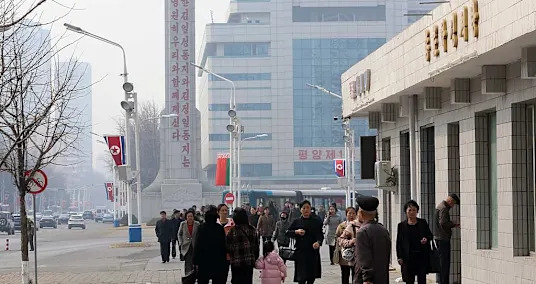
China has announced that its flag carrier, Air China, will resume direct flights to North Korea after a six-year pause, following the restoration of passenger train services between Beijing and Pyongyang.
This marks a significant step toward reopening North Korea, one of the world's most isolated nations, to the world.
Transport links between the two capitals had been suspended since the start of the Covid-19 pandemic in 2020, when Pyongyang implemented a very strict border closure.
While North Korean carrier Air Koryo already resumed flights to Beijing in 2023 and allowed Russian tour groups to visit in 2024, the return of China's air and railways are seen as a major economic milestone, as China has for decades been the main trading partner and a key source of diplomatic and economic backing for the country of 26 million people.
Before the pandemic, there were an estimated 300,000 foreign visitors in 2019, according to South Korea's Institute for International Economic Policy, and Chinese visitors accounted for 90% of all tourists to North Korea. Therefore, the long delay in resuming regular travel had surprised many regional observers.
"The reopening of these borders has been driven primarily by Pyongyang's timeline, which challenges the outdated assumption that Beijing dictates terms to a dependent client state," Seong-Hyon Lee, a visiting scholar at the Harvard University Asia Centre, explains.
Related
Nuclear ambitions complicated the relationship
Despite being Pyongyang’s primary ally, Beijing has frequently voiced disapproval over the North's persistent missile tests and nuclear ambitions. This aspect created a bumpy relationship with Pyongyang, with analysts saying that a nuclear-armed North Korea has often been something of a liability.
The diplomatic normalisation was highlighted last September, when Kim Jong Un attended a massive military parade in Beijing alongside Russian President Vladimir Putin. This was Kim's first appearance at a Chinese military display.
Lim Eul-chul, a North Korea expert at South Korea's Kyungnam University, argues that the war in Iran, in particular, increased "the need for closer coordination between the two nations".
LATEST POSTS
- 1
 Amid growing bipartisan scrutiny of Pete Hegseth, Trump says he 'wouldn't have wanted … a second strike' on alleged Venezuelan drug boat survivors
 - 2Fireballs and a full moon. Here’s how to see two celestial events this week
- 3Financial plan Cordial Home Redesigns That Add Worth
- 4The Manual for Electric Vehicles that will be hot dealers in 2023
- 5Cocoa Prices Undercut Amid the Prospects of Abundant Supplies


- Getting breast implants was a mistake I live with every day. Why I’m sharing my story now, at 70, in pain and afraid.
- The Most Compelling Innovation Advancements Somewhat recently
- Comet MAPS faces a make-or-break moment as it dives toward the sun on April 4 — could it shine in the daytime sky?
- Zendaya serves bridal-coded fashion with old, new and borrowed gowns for ‘The Drama’ press tour
- Tens of thousands protest as far-right AfD forms new youth group
- Astronauts' brains change shape and position after time in space, study finds
- Haifa refinery said hit in latest Iranian missile barrage
- Why are NASA's Artemis astronauts wearing orange? What are they bringing to space? What to know about the preparation for their moon mission.
- Illumina unveils dataset to speed up AI-powered drug discovery