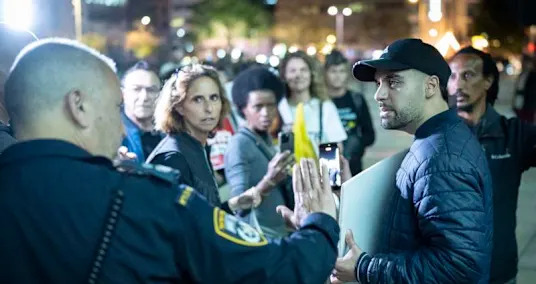
Protests took place in Tel Aviv, Jerusalem, Haifa, and Beersheba, as a survey found broad but uneven support among Jewish Israelis for Operation Roaring Lion.
Israel Police arrested 21 anti-war protesters Saturday night as demonstrations against the conflict with Iran expanded in multiple cities despite restrictions on public gatherings.
Protests took place in Tel Aviv, Jerusalem, Haifa, and Beersheba, with hundreds of participants reported in Tel Aviv and Jerusalem and about 100 in Haifa, marking the largest turnout since weekly demonstrations began. Authorities said 13 people were arrested in Tel Aviv and eight in Haifa.
Police said the gatherings were not approved under Home Front Command regulations that ban events with more than 50 people. Officials said the increase in turnout followed calls by groups opposing the government to protest despite the restrictions.
“During a situation assessment that took place at the scene with a Home Front Command representative… it was clarified that there was a real risk to human life and accordingly, Yarkon [precinct] police commander Tzachi Sharabi ordered the gathering to be dispersed,” police said.
Hadash-Ta’al chairman Ayman Odeh, an Arab lawmaker involved in the protests, criticized the police response, calling officers fascists “in the service of the government” and saying they were afraid of “the heroic citizens who went out, despite everything, to make their voice heard.”

Survey shows broad, uneven support for war
The demonstrations come as a March 2026 survey by the Israel Democracy Institute found broad but uneven support among Jewish Israelis for Operation Roaring Lion. Support was strongest on the Right at 87% and about half on the Left.
The survey also found that Jewish and Arab respondents largely agreed that Iran’s resilience has been stronger than expected. Most Jewish respondents said Israeli society could sustain the campaign for up to one month, while 28% said as long as needed. Arab respondents were less optimistic about how long the public could endure the conflict.
A majority of Jewish respondents said Prime Minister Benjamin Netanyahu’s decision was driven by security considerations, while most Arab respondents viewed it as political.
LATEST POSTS
- 1
 This Canadian crater looks like marbled meat | Space photo of the day for Jan. 6, 2026
 - 2Starfront Observatories: A haven for distant stargazers
- 3New York to require social media platforms to display mental health warnings
- 4Dark matter may be made of pieces of giant, exotic objects — and astronomers think they know how to look for them
- 5Expert advice for new stargazers: How to begin your amateur astronomy journey


- NASA Artemis II tracker: Where is the Orion now and when will it reach the moon?
- Moon rush: These private spacecraft will attempt lunar landings in 2026
- PHOTO ESSAY: Summer camp for kids with autoimmune diseases
- Can scientists detect life without knowing what it looks like? Research using machine learning offers a new way
- Picking the Right Pot for Your Plants: An Aide for Plant Devotees
- Germany records first wolf bite on human since repopulation
- Benin coup thwarted by loyalist troops, president tells nation
- Fundamental Home Items Each Animal person Needs
- This star-forming galaxy is blowing out powerful winds topping 2 million mph