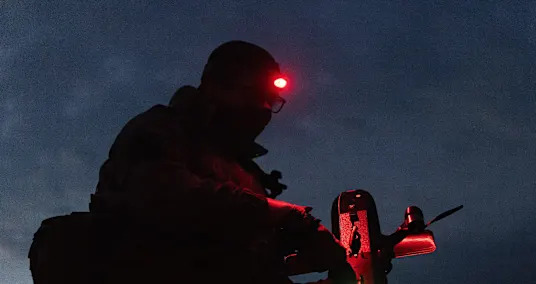
Ukraine has demonstrated its ability to rapidly adapt to a changing battlefield.
A top NATO commander said the Western military alliance needs to be able to do the same.
Part of this means fast-tracking new war technology.
A top NATO commander has said Ukraine's battlefield adaptation is impressive and that the alliance needs something like an "HOV lane" to fast-track new war tech.
In its four years of fending off Russia's full-scale invasion, Ukraine has demonstrated an "adaptation DNA," Adm. Pierre Vandier, NATO's Supreme Allied Commander Transformation, told Business Insider.
"That means that they've been very good at solving the problems at a very high speed. We haven't been accustomed to do that for decades," said Vandier, who oversees modernization efforts. He added that he wants NATO to adopt a sense of urgency in developing and procuring new weaponry like Ukraine has done.
The Western warships, aircraft, and armored vehicles that have dominated in past wars often take several years to build; the process can be even longer for newer designs.
The war in Ukraine has been defined by the overwhelming involvement of drones, robots, and other emerging technologies that move from the design phase to field testing and eventually into the hands of soldiers on a much quicker timeline.
In some cases, that process takes only weeks or months — any slower, and the product may become obsolete.
New tactics and countermeasures are evolving rapidly as well. For instance, early in the war, Ukraine had limited options to fight Russia in the Black Sea, so it created a fleet of exploding naval drones. When Moscow responded to this development by increasing combat aircraft patrols in the region, Kyiv armed the drones with surface-to-air missiles.

Senior Ukrainian officials have described the arms race as a cat-and-mouse game. NATO isn't driven by the same wartime pressures; however, officials and security experts argue it can't afford to relax.
Vandier said the war in Ukraine has demonstrated that the defense industry moves at two speeds: one for bigger, more complex systems, where development cycles last years, and another where necessary adaptation occurs every few weeks based on direct feedback from combatants.
The latter doesn't exist in the West, Vandier said. He compared the situation to a highway, explaining that the fast track is stuck behind a slow track. NATO needs "an HOV lane" for war technology so it moves at speed instead of getting stuck in traffic, he added.
NATO leadership recognizes it needs to change how it approaches the development of new tech and create a strong demand signal for industry. A challenge is that some legacy defense contractors remain focused on older procurement models, though newer startups are trying to more closely emulate Ukraine's industry.
"They want to enlarge the highway but not build the HOV," Vandier said of current NATO defense procurement efforts. So more of the same — more cars and more traffic jams. We need a fast track."
NATO officials like Vandier have long praised Ukraine's ability to adapt rapidly to changing battlefield dynamics. However, security experts have criticized the alliance for its sluggishness in preparing for modern warfare and for failing to address some of the threats seen on the battlefield.
"We need to apply a new model to understand what's going on, not only in Ukraine. It's the difference you have between a crisis and a shock," Vandier said.
In a crisis, he said, "you just want to reestablish what was broken or dysfunctional, and you go back to the previous model. When you are in shock, you need to invent something else because what you have in hand is not sufficient."
Read the original article on Business Insider
LATEST POSTS
- 1
 These 2 companies are teaming up to offer insurance for space debris strikes on satellites
 - 2NASA's Artemis astronauts enter final preparations for Moon mission
- 3CDC changes kids' vaccine schedule, removing universal recommendation for some shots
- 4There’s ‘super flu,’ COVID, RSV. Is it going around in SoCal?
- 5Hoist Your Style: Famous Hairdos for Ladies




- 2024 Manual for Light Extravagance Room Feel: What's Moving
- 7 Powerful Methods for forestalling Telephone Overheating: Keep Your Gadget Cool
- 100 new alien worlds: Scientists find hidden haul in data from NASA exoplanet-hunting spacecraft
- Kona SUV: Exploring the Future with Hyundai's Visionary Hybrid
- Tzrifin base exhibition reveals Hamas and Hezbollah arms, showing structure behind attacks
- As tetanus vaccination rates decline, doctors worry about rising case numbers
- More Than 110 New Species Discovered In Deep Waters Off Australia
- Trump signs bill allowing whole milk to return to school lunches
- Vote In favor of Your Favored Web-based Visual depiction Administration