Hanaan was 18 years old when she was raped by members of the Rapid Support Forces (RSF), a paramilitary group accused of committing widespread “war crimes” during nearly three years of fighting against Sudan’s army.
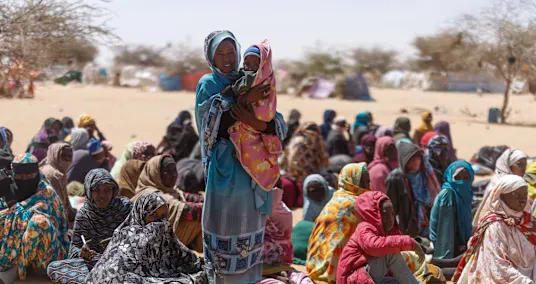
She was walking alongside a female friend to her makeshift home in an encampment for displaced people in South Darfur, when four men on motorbikes stopped them and asked where they were going.
“Two took each girl, and they raped us,” she told Doctors Without Borders, an international medical NGO known by its French initials MSF.
“I feel uncomfortable in my body, heavy. I don’t feel pain, apart from in my back – because they beat me, they beat me with their guns on my back,” she said.
Hanaan – not her real name – shared her testimony as part of a report released by MSF on Tuesday, which details the widespread use of sexual violence as a weapon in Sudan’s ongoing brutal civil war.
The NGO said 3,396 survivors of sexual violence sought treatment in MSF-supported health facilities across North and South Darfur between January 2024 and November 2025.
The data, presented in the report titled, There is Something I Want to Tell You…, was drawn from MSF programmes in just two of Sudan’s 18 states and reflects only a fraction of the crisis, while the true scale of the phenomenon remains unknown.
Women and girls accounted for 97 percent of survivors treated in MSF programmes. The RSF and allied militias were found to be primarily responsible for the systematic abuse.
Children among the survivors
“Sexual violence is a defining feature of this conflict – not confined to front lines, but pervasive across communities,” Ruth Kauffman, MSF emergency health manager, said in a statement.
“This war is being fought on the backs and bodies of women and girls. Displacement, collapsing community support systems, lack of access to healthcare and deep-rooted gender inequalities are allowing these abuses to continue across Sudan.”
Following the RSF’s capture of el-Fasher, the capital of North Darfur, on October 26, 2025, MSF treated more than 140 survivors fleeing to Tawila. Among them, 94 percent were attacked by armed men, with many reporting assaults along escape routes.
The assaults “deliberately targeted non-Arab communities as a means of humiliation and terror, echoing previous RSF atrocities such as the dismantling of Zamzam camp”, the report said. The RSF took control of famine-hit Zamzam camp in the western Darfur region after two days of heavy shelling and gunfire in April 2025.
Survivors described attacks not only during fighting, but in everyday settings, such as fields, markets and displacement camps.
Children were also among the survivors. In South Darfur, one in five survivors was under 18, including 41 children younger than five, the organisation said.
MSF called on the United Nations, donors and humanitarian actors to urgently scale up health and protection services in Darfur and all of Sudan, and on all parties to the conflict to cease and prevent sexual violence and hold perpetrators accountable.
LATEST POSTS
- 1
 Hamas propaganda expert explains Israel's internal conflicts influenced Hamas's Oct. 7 assault
 - 2Artemis II astronauts arrive in Florida to prepare for launch to the moon
- 3Ober Gabelhorn glacier reveals remains of man missing for over three decades
- 4Why the UAE has incurred the wrath of Somalia
- 5Vote In favor of Your Favored Web-based Venture Stage




- NASA probe captures stunning photos of Earth and moon on the way to infamous asteroid Apophis
- Iran executes two men who tried storming military facility during January protest crackdown
- 21 Things You Ought to Never Share with Your Childless Companion
- Why Cannes Is the Ultimate New Year’s Eve Destination in the South of France’s Off-Season
- Israel's fractured opposition hands Netanyahu a full term
- Smooth countdown continues for Artemis II moon mission
- Orcas seen hunting great white sharks to eat their livers in drone footage recorded in Mexico
- IDF kills four terrorists equipped with weapons, surveillance gear near Gaza's Yellow Line
- New research reveals urban raccoons across the US show early signs of domestication